"Follow the birds
to Victoria" is, for publicity purposes, one of
the most expressive ways of describing the quiet
charm of this lovely beflowered city on the
westerly edge of Canada. It is a charm that
draws thousands of visitors each year and,
correctly or not, causes the city to be likened
to a little bit of old England.
But behind the
gentle facade of Victoria there is an aspect of
an entirely different sort, for this is the main
outpost of Canada's Pacific defence
organization. Part of Victoria's complex is the
Canadian Forces Base at Esquimalt where the
movement of warships makes strong contrast to
that of brightly painted ferry boats bringing
visitors from the mainland.
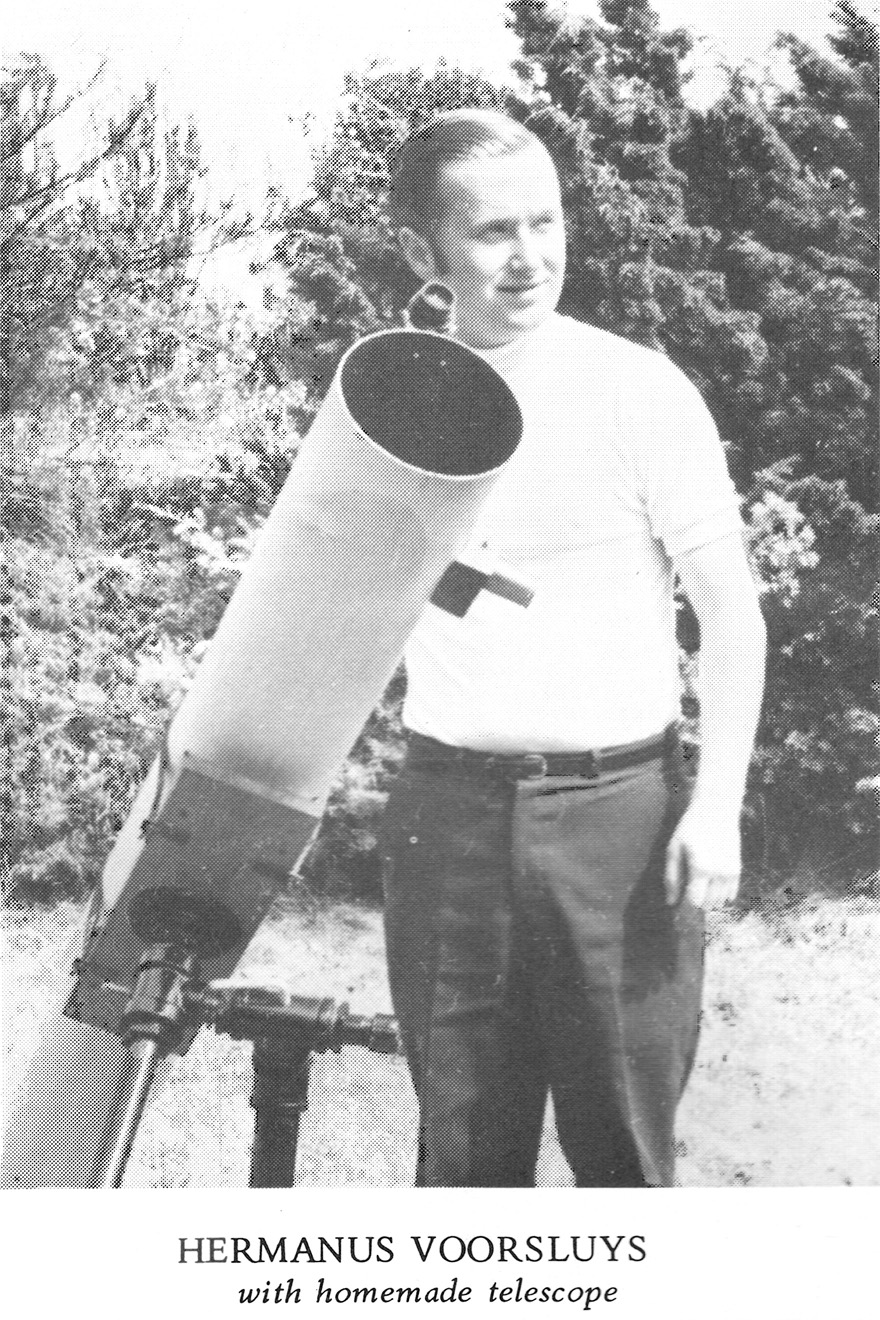
Hermanus
Voorsluys, an amateur astronomer, lives in a
section of Victoria where the southern vista
faces directly over Esquimalt. Inclined by habit
to look up at the night sky, he remembers a
September evening in 1968 when he noticed a
strange light high over the Esquimalt harbor.
"It was an orange
glow about 20 degrees above the horizon." he
told us. "It moved up slowly from the south and
hovered for a while, then it turned a fiery
red-orange and pieces of what looked like waste
material fell from it and floated toward the
ground. After this happened the glow became much
duller and suddenly went out as if turned off
like a light bulb."
On other evenings
after that he saw the same odd performance which
usually lasted several minutes and, becoming
deeply curious, he mentioned it to his neighbor,
Reginald Neal, a retired senior officer of the
police force in India, who joined him in keeping
watch.
Soon Neal was
also a witness to the mystery - and so later
were other members of their families and
neighborhood friends – with the result they
decided to record it on film. On September 29
between 8 and 8:30 p.m., with cameras in
readiness, they were rewarded with a clear
sighting of the object and took their pictures,
Neal used a telephoto lens.
On examining the
results they were convinced they had recorded an
occurrence beyond explanation and took steps to
bring it to official attention, with the result
that Voorsluys was interviewed three times by an
official of the Defence Research Naval
Laboratory in Victoria and Neal was interviewed
twice. Of Neal's photo this official said it was
"the best UFO shot" they had ever seen, the
plain implication here being that the witnesses
experience was by no means an isolated instance.
In filling out
the Canadian Forces debriefing form, Neal said:
"It certainly was not a heavenly body as it
changed course, moved at various speeds, changed
color from a blue white to a deep orange and
once turned deep red, and generally came to rest
for periods of time from a few seconds to
several minutes. The distance was too great to
make an estimation of shape. Also it was
generally too bright for such an estimation to
be made."
Voorsluys' report
was along the line already quoted.
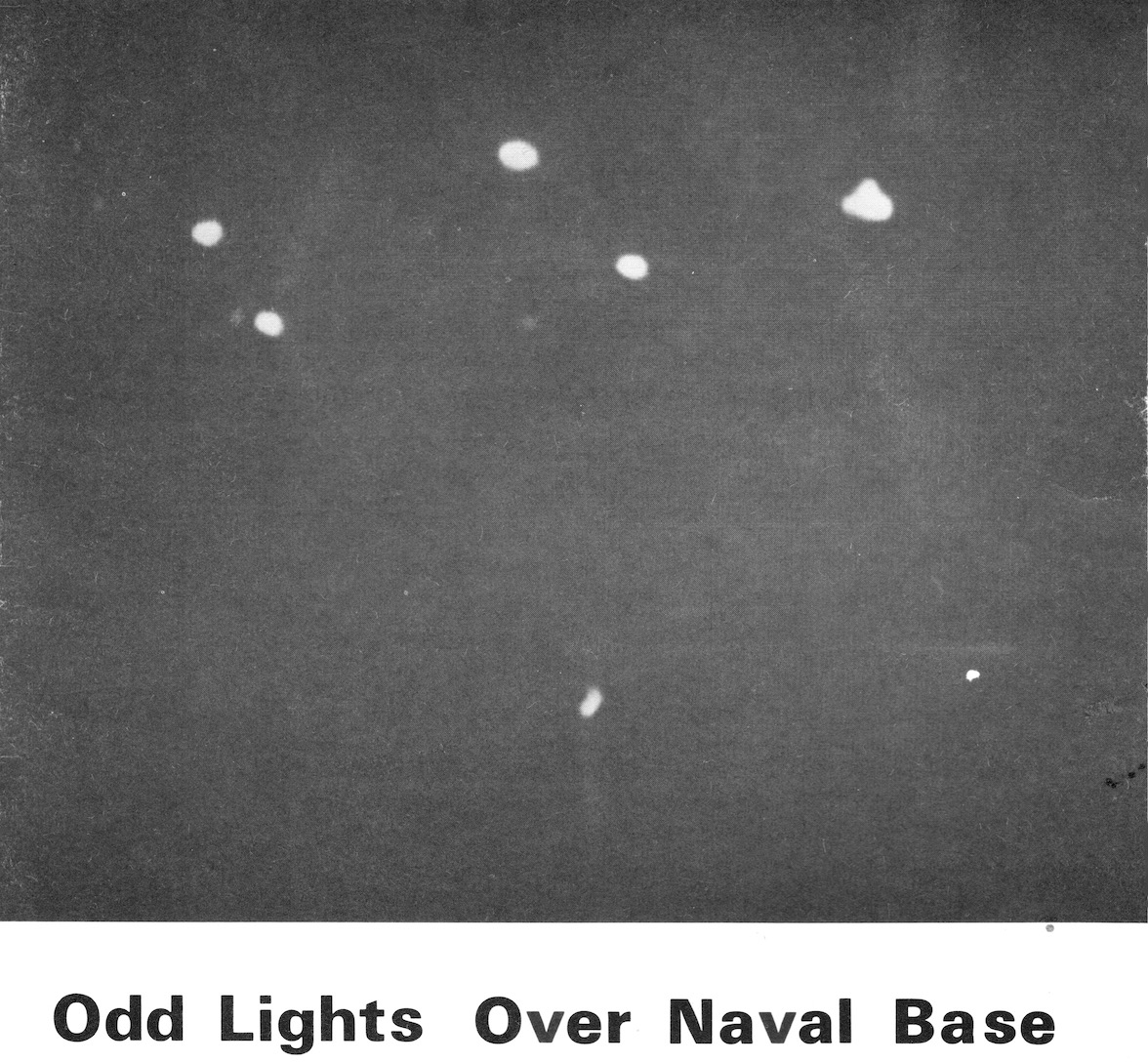
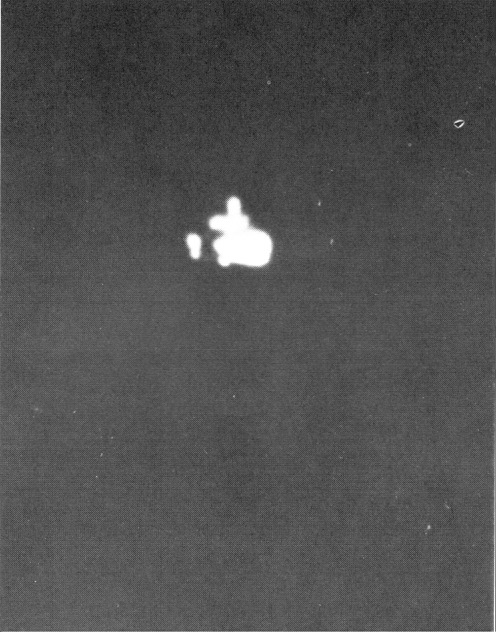
Enlargement
of our cover photo revealed this striking
configuration (above) of the principal object.
According to Reginald Neal who took the
picture, the four smaller objects appeared to
drop from the leading one and, after a
zig-zagging descent, returned to the level of
the parent body (as shown on cover) where they
then disappeared. Below the group a fifth
object is seen in the process of dropping. For
his telephoto picture, Mr. Neal used an Exakta
SLR camera with a 135 mm lens and Dynachrome
ASA 25 film. Setting was f3, exposed for 11
seconds.
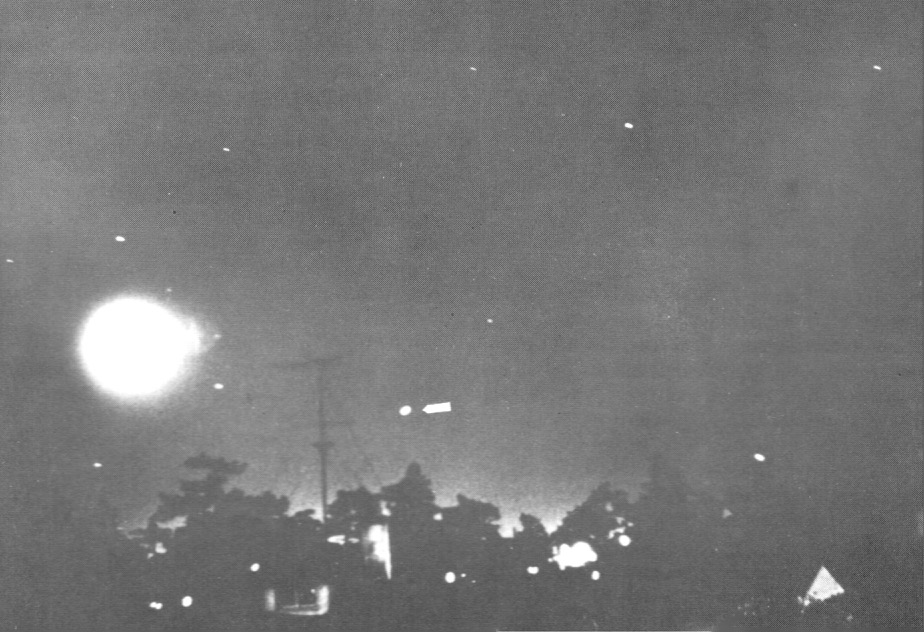 Hermanus Voorsluys' shot (above) shows the UFO
at a lower angle with neighborhood houses,
lights and trees in foreground. Bright light at
left is the moon and other lights in the sky are
stars, all identified by a professional
astronomer who could not explain the object in
question. Mr. Voorsluys used a Minolta 35 mm
camera with Kodachrome ASA 25 film. His setting
was f2 with 10-second exposure.
Hermanus Voorsluys' shot (above) shows the UFO
at a lower angle with neighborhood houses,
lights and trees in foreground. Bright light at
left is the moon and other lights in the sky are
stars, all identified by a professional
astronomer who could not explain the object in
question. Mr. Voorsluys used a Minolta 35 mm
camera with Kodachrome ASA 25 film. His setting
was f2 with 10-second exposure.
Despite the
interviews in Victoria, the final analysis lay
with the National Research Council in Ottawa, to
which four photos of the object were sent.
Eventually this reply came from an official
there:
"Unfortunately I
am unable to come to a definite conclusion on
the basis of what evidence appears on your
photos. One thing I am fairly certain of,
however, the detail shown in the object observed
is probably due to slight motion of the camera,
and not to true detail in the object observed.
The other images, which may be stars or lights
on the horizon, show evidence of the same
structure. I would think that what you
photographed was a point source of light which
confirms your visual observations. Its intensity
relative to the stars would suggest that it was
either a flare, an experimental balloon with a
light or possibly an experimental aircraft."
It was apparent
from these remarks that the NRC did not
investigate the case closely, if at all,
otherwise it would have ascertained, as the
witnesses did, that there was no balloon or
flare in the vicinity at the time. A lighted
balloon was released that night by the Sydney
(Victoria) weather office but this was at least
45 minutes after the two men had made their
sighting.
Signal flares are
released from time to time by the U.S. Coast
Guard at Port Angeles, Wash., over 30 miles to
the south, but these reach a height of only a
few hundred feet and are not visible beyond
about 15 miles.
A more likely
possibility would have been one of the
illumination flares also fired occasionally from
Port Angeles. Dropped from aircraft about 3,000
feet up, these parachute suspended flares are
visible up to 50 miles away on a clear night but
their maximum duration is three minutes. The
strange light seen by the two witnesses lasted
at least 15 minutes. Moreover it did not appear
to be dropping. It moved about and hovered.
Since there was virtually no wind that night,
these would hardly be the antics expected of a
parachute.
As for an
experimental aircraft, that one is always in the
grab-bag of guesses but if it was such a craft,
it was strangely unventuresome. As Voorsluys
remarked, it repeated almost identically the
same performance on several different nights.
One would think an experimental aircraft would
have more assorted ways to spend its time.
There was one
other circumstance which, though omitted from
the official report because it did not occur on
the night in question, may have a significant
bearing on the case. Twice the witnesses
detected what they described as a "very low
vibrating noise" that they thought was
associated with the object. It is arguable that
the noise was one of the sounds of the city. But
in one of the instances they heard it, they were
not in the city. Curious about the fiery looking
pieces discharged by the object, they had driven
well out of town to a beach where they thought
the pieces might have landed. They found nothing
unusual and the light had disappeared, but as
they stood there in the quietness by the water,
they became aware of the strange noise, unlike
anything they had heard before.
“It was a low
bass-like vibrating noise,” Voorsluys said. “We
could feel and hear this sound but it was
impossible to tell where it came from no matter
where we looked. It sounded like it was coming
from all over the area.”
In Winnipeg,
Brian Cannon, then director of CAPRO who has
since set up his own UFO research center,
followed the case with particular interest.
Having compiled a full report on it, he
concluded with these remarks:
"Based on
available information, it is difficult to
explain this sighting away as a result of
misidentification of a balloon or flare. It is
apparent there were no balloons in the vicinity.
There would appear to be a definite difference
of opinion between the two witnesses as
regarding the speed of the main object.
Voorsluys felt that it was moving at least as
fast as “a jet interceptor.” Neal, who did not
compare its speed with a conventional object,
stated it moved from a point five degrees above
horizon to 10-15 degrees above horizon in “3-5
minutes.”
"The duration of
the sighting, as described by both witnesses,
would seem to rule out the flare possibility.
Both men are fairly conversant with various
types of aircraft and felt that this hypothesis
was also not applicable to the sighting."
Among questions
that may come to readers minds are: Why did the
object seem to favor one particular spot over
Victoria, and why were the sightings apparently
limited to the two witnesses and others in their
immediate neighborhood?
The answer to the
first must, as with so many things concerning
UFOs, be sheer guess-work. But significantly the
object seemed to be almost directly over a new
high voltage transmitter near the Esquimalt navy
base. This, plus activity at the base itself,
might have made the area one of special
attraction to the object.
As to the second
question, there was no way of telling how many
others saw the object without reporting it, but
there was at least one other known witness whose
qualifications added immense weight to the
report of the other two. This was James R.
McLean, a commercial aircraft pilot, who said
that while flying over Victoria one night during
the period in question he saw a glowing object
he could not explain. His description of it
matched that of Voorsluys and Neal, though at
the time they were strangers to him. McLean came
forward when a local newspaper carried a letter
by Voorsluys seeking other witnesses. He made
himself known to Voorsluys, not to the
newspaper, thus eliminating any suggestion that
his report might have some publicity value.
There the case
rests at the moment, but it rests without the
smallest clue to an answer. The reports and
photos of the witnesses remain completely
unexplained. It is far more difficult to scoff
at this case than to accept the probability that
something unknown to us moved across the night
sky of Victoria.

 HOMEPAGE